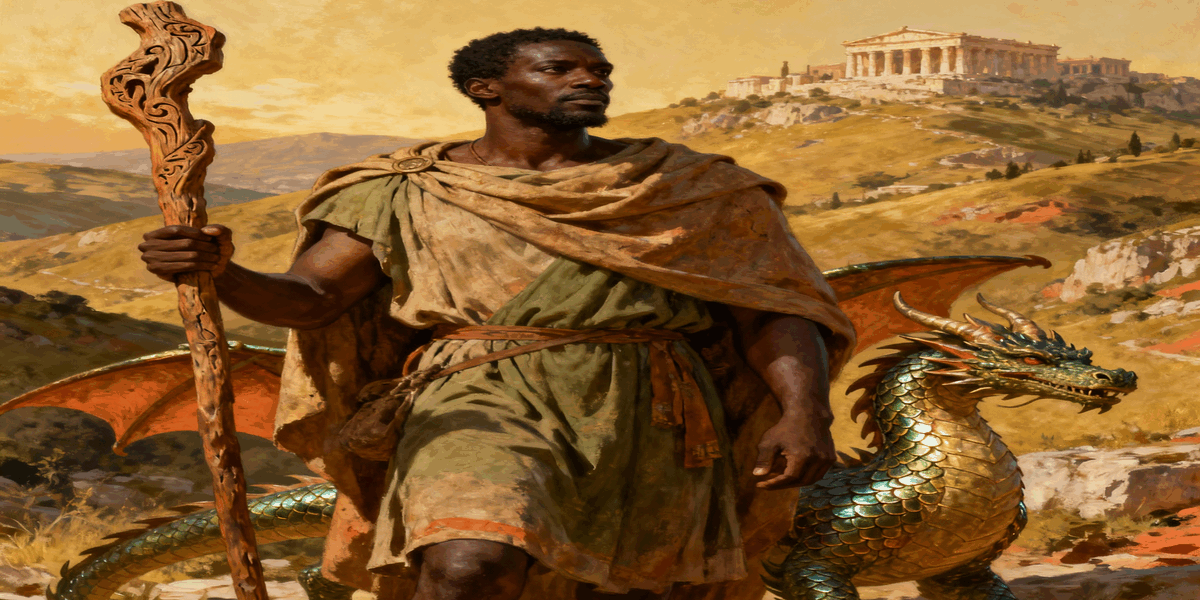
In A Theban Tale, my reimagined adaptation of Sophocles’ Oedipus, I’ve worked to remain true to the origins of Greek myth, history, and culture.
The other night, I shared a portion of my story with an old childhood friend from North Carolina, who is also of Greek heritage. I wanted his thoughts on the direction I was taking. He laughed and told me, “It wouldn’t sell… it needs some Black people!” He went on to explain that while Greek history is often portrayed as populated entirely by lighter-skinned figures, he believes many dark-skinned people also played a role in Greek history and mythology.
Inspired by this, I revisited a character I had already created for the story. A figure central to the plot, and reimagined him as a Black Greek. His name is Agapius. A shepherd while out hunting with his mystic creature, Draco, He stumbles upon an abandoned newborn. He presents the child as a gift to the King and Queen of Corinth, Polybus and Merope, who have longed for but never been able to have children. In gratitude, the royal couple appoint Agapius as their trusted advisor and the teacher of young Oedipus.
Agapius is now envisioned as a Black man, a figure of balance, strength, and intellect, embodying the very meaning of his name: “Love.”
“Thebes will never forget. The gods will never forgive. And the curse will never die.”
